

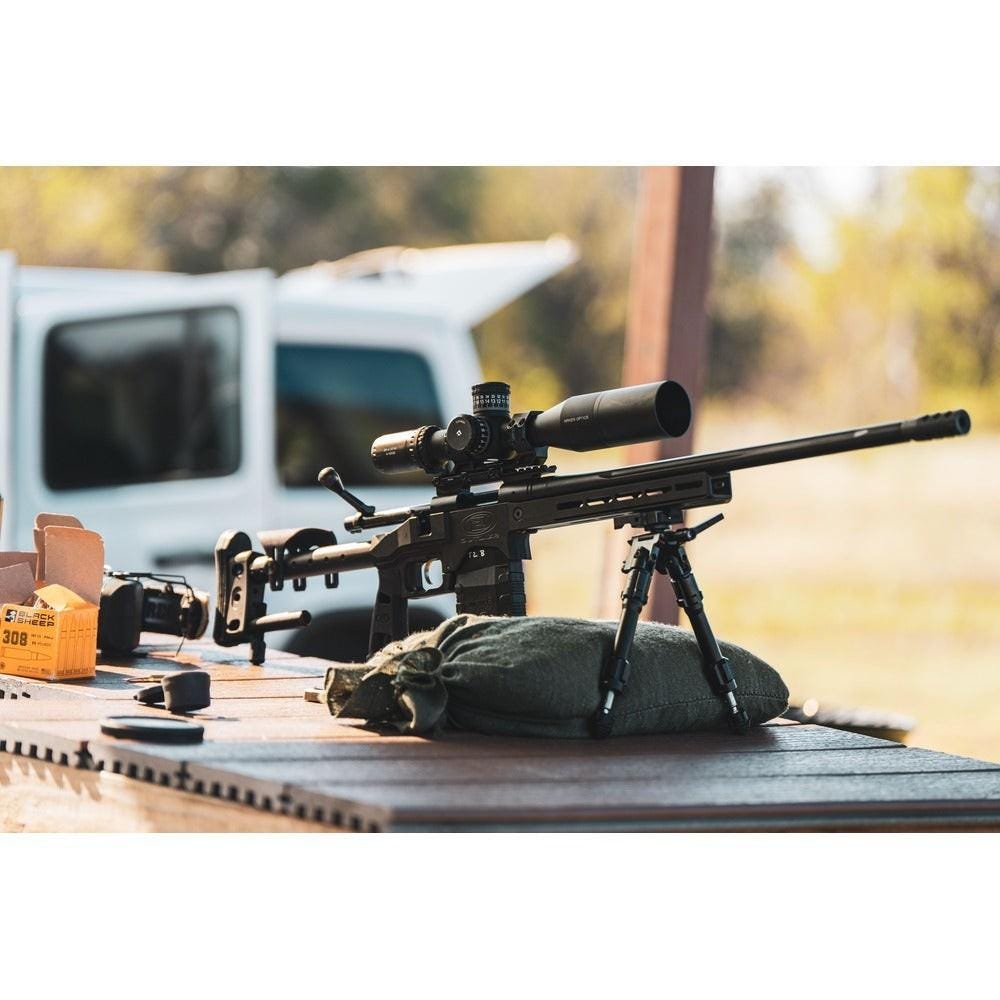
A closer look at ARKEN’s new all-round hunting riflescope
By Canadian Gunz
If you spend enough time looking through rifle scopes, you quickly realize that there is no such thing as a perfect optic.
Some scopes are built for close-range hunting.
Others are designed for long-range shooting.
Some prioritize lightweight construction, while others give you huge amounts of elevation adjustment, massive magnification, and features aimed squarely at the precision-rifle crowd.
But what happens when you try to combine those worlds?
That is exactly what caught my attention with the ARKEN OUTRIDER 3-18×50.
ARKEN describes the OUTRIDER as its first all-round hunting scope, and on paper, it certainly looks like an interesting combination of hunting-friendly features and long-range capability.
With a 3-18x magnification range, 50mm objective, Japanese HD glass, side-focus parallax adjustment, a 30mm tube, and an illuminated FDR reticle, this scope is clearly designed for hunters who want more capability without moving into a massive tactical-style optic.


And after spending time looking at what this optic offers, the question becomes pretty simple:
Is the OUTRIDER 3-18×50 actually a practical hunting scope, or has ARKEN simply built another long-range optic wearing hunting clothes?
Let’s take a closer look.
3-18x: A Serious Magnification Range for Hunting
One of the first things that stands out about the OUTRIDER is the 3-18x magnification range.
Three power gives you a reasonably wide field of view for closer shots, while 18x gives you considerably more magnification than most traditional hunting scopes.
At 100 yards, ARKEN lists a field of view ranging from approximately 39 feet at 3x down to 6.5 feet at 18x.
That is a significant range.
At the low end, 3x makes the scope usable for typical hunting situations where you may need to find an animal quickly.
At the high end, 18x gives you the ability to examine a target, hold more precisely, and take advantage of the rifle’s accuracy potential when distances start stretching out.
And that is really where the OUTRIDER starts to separate itself from a traditional hunting optic.
A conventional hunting scope might stop at 9x, 10x, or 12x.
The OUTRIDER keeps going.
The 50mm Objective
The second major feature is the 50mm objective lens.
A larger objective can help provide the shooter with a brighter image and a larger exit pupil at higher magnifications, although actual low-light performance depends on much more than objective diameter alone.
ARKEN says the OUTRIDER uses Japanese HD glass along with Super Bright Fully Multi-Coated optics and claims more than 90 percent light transmission.
ARKEN describes a hydrophobic lens coating for wet weather.
Second Focal Plane — And Why It Matters
The OUTRIDER is a second focal plane, or SFP, scope.
That means the reticle remains the same apparent size as you change magnification.
For a traditional hunting scope, there are some real advantages to this.
At lower magnification, the reticle remains relatively easy to see.
At higher magnification, you get a larger target image without the reticle becoming proportionally larger.
The trade-off is that the reticle’s subtensions are only calibrated for a specific magnification, depending on the reticle design.
For a hunter who primarily uses the scope for straightforward aiming rather than constantly dialing or using reticle subtensions, SFP can be a perfectly practical choice.
The FDR Reticle
One of the more interesting features of the OUTRIDER is the FDR reticle.
FDR stands for Fiber Duplex Reticle.
ARKEN describes it as having a daylight-bright center aiming point, with six illumination brightness levels.
This is quite different from a complicated Christmas-tree-style long-range reticle.
The idea here is simplicity.
You have a familiar duplex-style hunting reticle, but with an illuminated center aiming point.
That can be useful when the background behind the animal makes a conventional black reticle difficult to see.
It also keeps the sight picture relatively uncluttered.
For hunting, I think that is an important consideration.
You don’t necessarily need a reticle that looks like an engineering blueprint when you’re trying to put a crosshair on a deer standing in the bush.
Adjustable Parallax From 10 Yards to Infinity
The OUTRIDER also gets side-focus parallax adjustment from 10 yards to infinity.
That is an unusually broad range for a hunting scope.
Most importantly, it gives the shooter considerably more control over parallax error when shooting at different distances.
At 100 yards, you can set the parallax appropriately.
Move farther out and you can adjust accordingly.
Move much closer and the scope is still capable of focusing down to 10 yards.
That versatility makes the OUTRIDER suitable for more than just hunting.
It can also make sense for range work, zeroing, load development, and recreational precision shooting.
Turrets and Adjustment Range
This is where the OUTRIDER starts showing some of its ARKEN DNA.
The scope uses 0.25 MOA adjustment clicks, with 15 MOA per revolution.
ARKEN lists:
56 MOA total elevation adjustment
48 MOA total windage adjustment
CCW turret rotation
No zero stop
That gives the OUTRIDER a considerable amount of adjustment for a hunting optic.
The 56 MOA of elevation is particularly useful if you’re setting up a rifle for longer-range shooting.
However, the absence of a zero stop is something potential buyers should be aware of.
That’s not necessarily a deal-breaker for a hunting scope, but shooters who regularly dial elevation and are accustomed to a mechanical zero stop may consider it an important difference.
Built for the Field
The OUTRIDER isn’t designed simply as a range optic.
ARKEN lists several features intended for hard field use.
The scope is constructed from aircraft-grade aluminum, is IP67 waterproof and dustproof, and is nitrogen purged for fog resistance.
ARKEN also states that the scope is.50 BMG recoil rated.
The important point isn’t that you should put a.50 BMG behind it just because ARKEN says it can handle it.
The more relevant takeaway for the average hunter is that ARKEN has designed the optic with durability in mind.
The Numbers
Here are the key specifications for the OUTRIDER 3-18×50:
The model discussed here is the 3-18×50, with a 30mm tube and second-focal-plane reticle. The FDR and DLR versions have different illumination and weight specifications.
Is 18x Too Much for Hunting?
This is probably one of the biggest questions surrounding the OUTRIDER.
Do you really need 18x for hunting?
The honest answer is: it depends on how and where you hunt.
If you’re hunting thick timber and most of your shots are inside 100 yards, you’re probably not going to spend much time at 18x.
But that isn’t really the point.
The advantage of having 18x is that you don’t have to use it all the time.
You can run the scope at 3x, 4x, 6x, 8x, or 10x when the situation calls for it.
Then, if you’re sitting on an open field and an animal appears several hundred yards away, you’ve got considerably more magnification available.
That versatility is what makes the 3-18x range interesting.
The Weight Trade-Off
There is, however, a trade-off.
The OUTRIDER isn’t a featherweight hunting scope.
The FDR version weighs approximately 29.2 ounces, and the DLR is approximately 28.2 ounces.
For a lightweight mountain rifle, that may be more optic than you want.
But for a general-purpose hunting rifle, especially a rifle that may also see significant range time, the weight becomes easier to justify.
This is really where the OUTRIDER sits in the market.
It isn’t trying to be the smallest hunting scope possible.
It’s trying to give the hunter a broad range of capability in one optic.
FDR vs DLR
ARKEN offers the OUTRIDER in two reticle configurations.
The FDR gives you the illuminated fiber duplex reticle.
The DLR uses a traditional duplex reticle without illumination.
That creates a fairly straightforward choice.
If you like illuminated reticles and expect to hunt in changing light conditions, the FDR version gives you that additional capability.
If you prefer a simple traditional duplex reticle and don’t need illumination, the DLR keeps things more straightforward.
Both are second focal plane designs.
My Take on the ARKEN OUTRIDER 3-18×50
What I find most interesting about this scope isn’t any single specification.
It’s the combination.
You have:
3x on the low end.
18x on the high end.
A 50mm objective.
Japanese HD glass.
Side-focus parallax from 10 yards to infinity.
56 MOA of elevation.
48 MOA of windage.
A 30mm tube.
And an illuminated duplex-style reticle option.
That’s a pretty broad set of capabilities.
The OUTRIDER is clearly aimed at the hunter who doesn’t want to own one scope for hunting and another scope for long-range shooting.
Instead, ARKEN is trying to create an optic that can cover both jobs.
Who Is This Scope For?
I think the most obvious customer is the hunter who spends time in open country.
Think western hunting, fields, cutlines, mountains, farmland, and other environments where shots can potentially stretch beyond traditional hunting distances.
It’s also an interesting option for someone who wants to use the same rifle for hunting during the season and range shooting during the rest of the year.
The 3x low end keeps it practical.
The 18x high end gives you considerably more precision capability.
And the 50mm objective gives you a substantial amount of glass without moving into the enormous 56mm-plus tactical optics that have become increasingly common.
What About the 2-12×42?
ARKEN also offers an OUTRIDER 2-12×42, and the two scopes are aimed at slightly different applications.
The 2-12×42 is smaller and lighter.
The 3-18×50 gives you more magnification and is more oriented toward longer-range applications and open-country hunting.
So this isn’t necessarily a case of one being better than the other.
It comes down to the rifle, the terrain, and how you intend to use the optic.
If you’re building a lightweight mountain rifle, the smaller scope may make more sense.
If you’re building a general-purpose hunting rifle that may also spend considerable time on the range, the 3-18×50 becomes a much more interesting proposition.
Final Thoughts
The ARKEN OUTRIDER 3-18×50 is an interesting direction for ARKEN.
Instead of building another optic specifically for the tactical or precision-rifle market, ARKEN has taken many of the features that long-range shooters appreciate and put them into a scope designed specifically around hunting.
The 3-18x magnification range is probably the biggest selling point.
It gives you enough low-end magnification for normal hunting situations while providing a substantial amount of power when distances stretch out.
The 50mm objective, Japanese HD glass, side-focus parallax, large adjustment range, 30mm tube, and FDR illuminated reticle add even more versatility.
There are compromises.
It’s not the lightest hunting scope available.
And the lack of a zero stop may matter to some shooters.
But if you’re looking for an optic that can move between hunting, range shooting, and longer-distance applications, the OUTRIDER 3-18×50 deserves a serious look.
The bigger question isn’t whether you need 18x.
The question is whether having that extra capability is worth carrying a little more weight.
For many hunters, especially those hunting open country, that may be exactly the trade-off they’re looking for.
Leave a Reply