

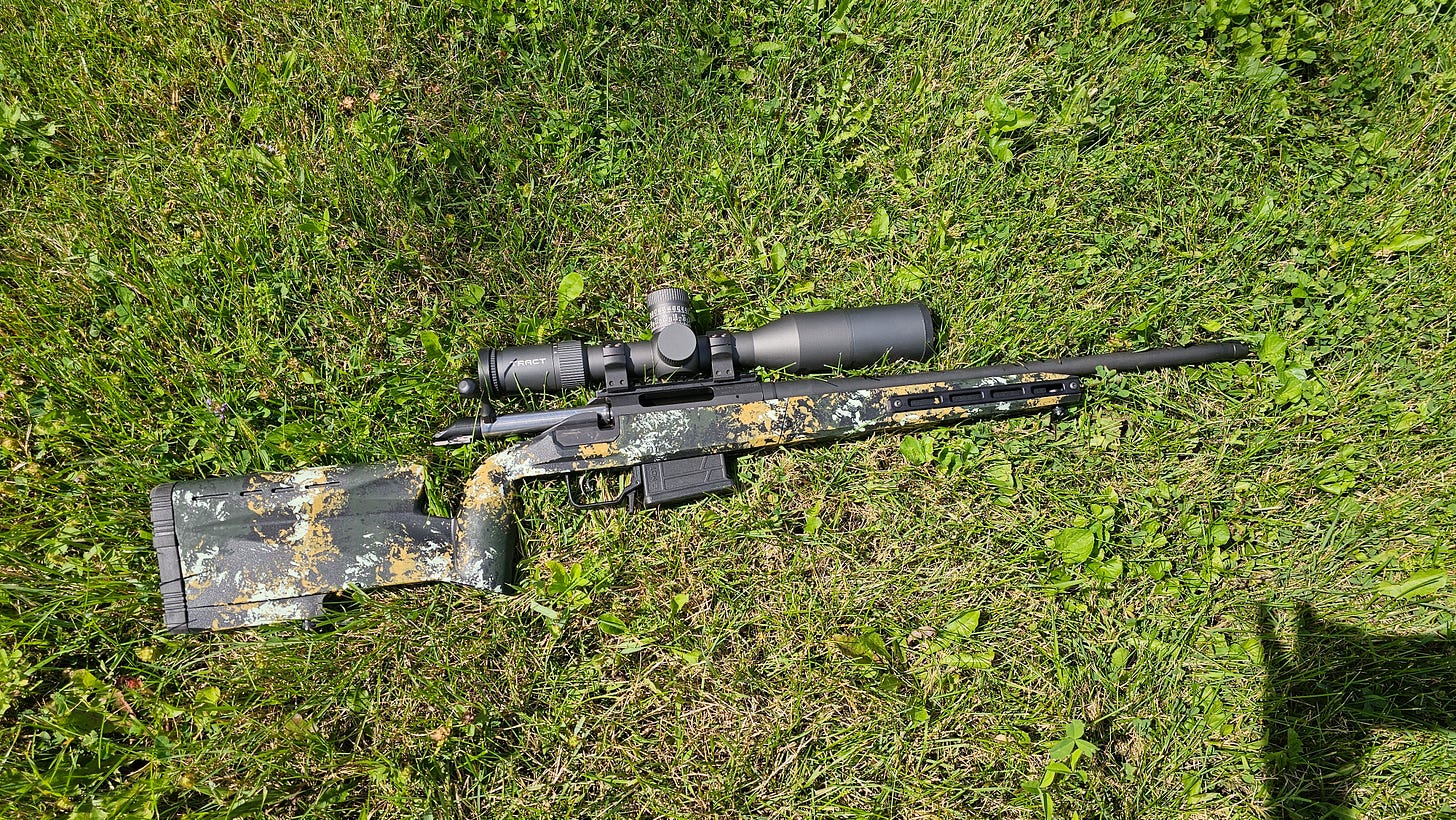
There are some rifle upgrades that look good on paper but don’t necessarily make much difference once you get them out into the real world. Then there are upgrades that make you wonder why the rifle didn’t come that way in the first place.

The Grayboe Halo stock falls somewhere between the two. After putting one on my Glenfield rifle and taking it to the range, I came away pretty impressed. The Glenfield was already a very good-shooting rifle, so the question wasn’t whether I could make it shoot well. The question was whether the Grayboe Halo could actually make it shoot even better.
After testing it with three different loads, my answer is yes. And, as an added bonus, I think it made the rifle look a whole lot better.
The Grayboe Halo Stock
The Grayboe Halo is made from an impact-resistant polymer designed to be tough and weather resistant. This isn’t a lightweight stock designed primarily around saving every ounce possible. Instead, the Halo is built around rigidity, ergonomics and versatility.
I liked the camo finish on the stock I tested. In my view, it suited the Glenfield and gave it a more modern look.
The Halo stock and Universal Mini Chassis are separate parts of the system. You need to account for both, rather than treating the stock alone as the complete upgrade.
That’s certainly not a cheap stock upgrade, but the UMC is also what makes the Grayboe system particularly interesting.
The Universal Mini Chassis Is the Real Game Changer
The UMC is what makes the system interesting. With the correct action-specific inlet, it gives you options to use a compatible Grayboe stock. That doesn’t mean every UMC fits every rifle.
The concept is actually pretty clever. You can have your barreled action with the UMC already installed and then move that action into a compatible Grayboe stock whenever you want to change things up. Rather than having to purchase a completely different stock for every rifle, the UMC gives you considerably more flexibility.
For someone who owns multiple rifles or likes experimenting with different setups, that’s a pretty interesting proposition.
Installation Takes a Little Getting Used To
I’ll admit that installing the system wasn’t completely intuitive for me the first time. Getting the UMC attached to the barreled action and then getting everything positioned correctly inside the Halo took a little bit of figuring out.
My advice would be to watch the installation videos Grayboe provides before starting the job. It will save you some frustration.
I also ran into a small issue with the trigger pull-weight adjustment screw. It had worked itself out farther than it should have and initially interfered with getting everything properly seated. Once I adjusted the screw, the action dropped into place properly and everything lined up as it should. The safety also lined up correctly.
Once everything was installed, the system felt solid and secure.

A Rigid, Free-Floated Platform
One of the first things I noticed about the Halo was the substantial insert inside the fore-end. Although the stock itself is polymer, that internal structure gives the fore-end considerable rigidity.
There is still a little bit of flex in the polymer, but importantly, the barrel does not contact either side of the stock. That leaves the barrel completely free-floated.
For a hunting rifle, having a rigid stock and a properly free-floated barrel can be important for maintaining consistent accuracy. That was one of the things I particularly wanted to see when I took the Glenfield to the range.
The Accuracy Test
This was the part of the test I was most interested in.
The Glenfield had already proven itself to be a very accurate rifle, so I didn’t want to simply shoot a few rounds and declare the stock a success. Instead, I took three different loads to the range and put the rifle through its paces.
We shot three loads at 100 yards. I found the results encouraging, especially because the Glenfield had already been a good shooter before the conversion.

I also tried a 130-grain load in a three-shot group.

The last load was tested with five shots, so it wasn’t the same shot count as the three-shot group.
The important takeaway for me was that all three loads grouped below one inch in my testing.

The Grayboe Halo didn’t magically transform an inaccurate rifle into a precision rifle. The Glenfield was already shooting very well. Instead, the stock seemed to complement what was already a very good-shooting rifle.
And that’s an important distinction.
So, Does the Halo Actually Make It Shoot Better?
In my opinion, yes.
Obviously, one range session isn’t enough to make a scientific claim that a stock will universally improve every rifle. But with this particular Glenfield, the results were certainly encouraging.
The rifle was already shooting well, and after installing the Halo, I was consistently getting sub-one-inch groups with multiple loads. The additional rigidity and free-floating design certainly don’t hurt.
The Halo also changes the way the rifle feels in your hands. The ergonomics are much more modern, and the grip gives you a more vertical hand position. There is also a fairly pronounced palm swell.
The palm swell is a little thicker than what I’m normally used to, so it took some time to get accustomed to it. Once I did, however, I found it comfortable, and it didn’t negatively affect my shooting.
M-LOK and QD Sling Mounts
Another advantage of the Halo is how adaptable it is compared with a traditional hunting stock.
There are four M-LOK slots on each side, along with additional M-LOK mounting positions underneath. That gives you plenty of options for adding accessories.

For example, if you’re someone who likes shooting from a tripod, you could install a short Arca-style rail underneath the stock. That would make the rifle much more versatile when shooting from a supported position.
The stock also has QD sling mounting points at both the front and rear. I added QD sling swivels to mine, and I think they work particularly well for a hunting rifle.
The AICS Magazine System
One thing Glenfield owners need to know is that the original magazine isn’t compatible with the Halo’s magazine well.
The UMC uses an AICS-style magazine system instead.

For this review, I used an MDT polymer five-round magazine, and it inserted and removed without any problems. I also experienced no issues cycling rounds through the rifle.
The magazine system has an adjustment screw that allows you to make adjustments if necessary to ensure proper feeding.
Personally, I don’t need a large-capacity magazine on a hunting rifle. Realistically, I’m probably going to fire two or three rounds at most when hunting deer. If I haven’t got the deer after that, I’ve probably got bigger problems than magazine capacity.
A Comfortable Hunting Stock
The Halo’s grip is one of its more distinctive features. It’s relatively vertical and has a pronounced palm swell that fills your hand nicely. The molded texture also gives you a secure grip.
At the rear of the stock, there’s a small bag-rider-style section that can be useful when shooting from a bench or other supported position.

The recoil pad is another feature I really liked. It’s quite soft and does a good job of absorbing felt recoil. The rifle I’m using is a 6.5, so recoil isn’t particularly brutal to begin with, but without a suppressor or muzzle brake, you can still feel some kick.
The soft recoil pad makes the rifle noticeably more comfortable to shoot.
The One Thing I’d Change
If I could add one feature to the Halo, it would be an adjustable cheek rest.
The stock doesn’t have an adjustable comb, and I think that would make a modern hunting stock like this even better. It’s certainly not a deal breaker, and there are aftermarket solutions available, including padded cheek risers and wraps that can provide additional height.
Still, an integrated adjustable cheek rest would make getting the perfect cheek weld and optic alignment much easier.
The Weight Trade-Off
As with almost every upgrade, there is a trade-off.
The Halo makes the rifle more substantial, and the Glenfield isn’t exactly a featherweight rifle to begin with. Adding the heavier stock and chassis means you’ll be carrying more weight through the woods.
If you’re spending all day hiking through rough country, that’s something worth considering.
On the other hand, that additional weight can also make the rifle more stable when shooting. For the way I intend to use this rifle, I think the trade-off is worth it.
The Good and the Not-So-Good
After spending time with the Grayboe Halo, there are quite a few things I really like about it. The biggest positives for me are the rigidity of the stock, the free-floated barrel, the modern ergonomics and the versatility of the Universal Mini Chassis. The M-LOK slots provide plenty of options for mounting accessories, while the QD sling attachment points are a nice touch for a hunting rifle.
I also really like the AICS-style magazine system. The MDT five-round magazine I used fed and cycled without any problems, and I personally prefer that setup to the original magazine on the Glenfield.
The Halo also gives the rifle a much more modern feel without turning it into something that doesn’t belong in the woods. The grip is comfortable once you get used to the larger palm swell, and the soft recoil pad does a good job of taking some of the sting out of the rifle. Most importantly, in my testing, the Glenfield continued to shoot extremely well after the conversion, with all three loads producing groups under one inch.
There are a few compromises. The stock and mini chassis are separate purchases, installation took some patience, and I would have liked an adjustable comb.
Installation also has a bit of a learning curve, although once you understand how the UMC and barreled action fit together, it’s fairly straightforward.
The other drawback is weight. The Halo and chassis make the rifle more substantial, and the Glenfield wasn’t exactly a lightweight rifle to begin with. If you’re carrying it all day through the mountains, you’ll definitely notice the extra weight.
I also would have liked to see an adjustable cheek rest. With a modern stock and a larger scope mounted on top, an adjustable comb would make getting the perfect cheek weld that much easier.

So, like most things, there are some compromises. You’re paying more, you’re adding some weight, and installation takes a little patience. But in return, you’re getting a very rigid, versatile and modern platform that, at least on my Glenfield, appears to have complemented an already accurate rifle very well.
The Verdict

So, would I put a Grayboe Halo on this Glenfield again?
Absolutely.
The rifle was already a good shooter, but the Halo gives it a much more modern platform. The stock feels solid, the barrel is properly free-floated, the ergonomics are excellent once you get used to the palm swell, and the AICS magazine system is something I personally prefer over the original magazine setup.
And then there’s the accuracy.
Three different loads, ranging from 130 to 143 grains, and all of them produced groups under one inch in my testing.
That’s pretty impressive for a hunting rifle.
But there’s another factor that doesn’t show up on a target.
I actually like the rifle more now.
It feels more substantial. It looks better. It gives me more options for mounting accessories. And it has the kind of modern ergonomics that make you want to pick the rifle up and go hunting.
This isn’t just a cosmetic swap. If you already like the rifle and want a more versatile stock and magazine setup, I think the Halo is an interesting option.
For me, this Glenfield is now looking like one of the rifles I’ll be taking into the deer woods.
Winner, winner — what’s for dinner?
Thanks for reading, and as always, stay safe and enjoy the outdoors.
— Canadian Gunz
Leave a Reply